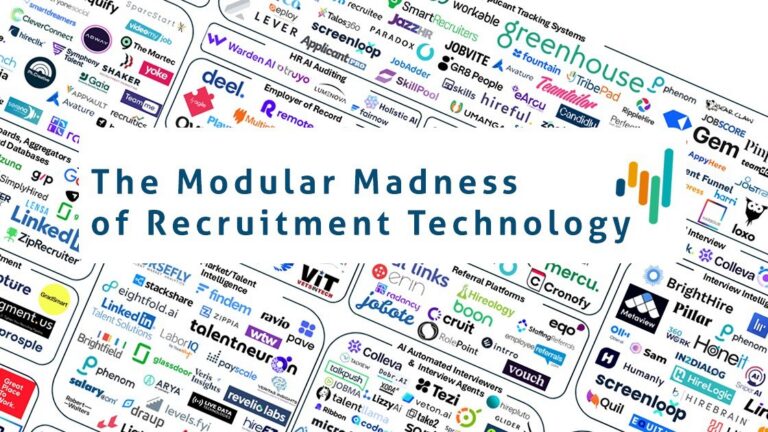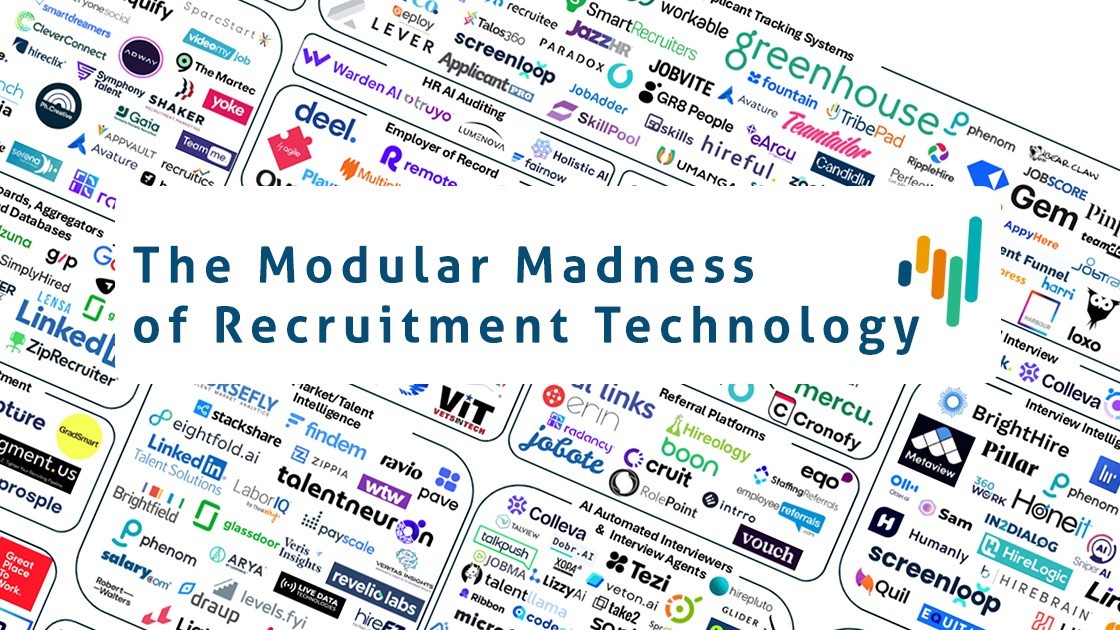
If you’ve ever tried to map the recruitment technology ecosystem, you’ll know it’s a bit like trying to nail jelly to a wall. Every time you think you’ve got a clean structure, another vendor appears, another employer switches platforms, and another “revolutionary” tool launches that promises to fix hiring forever. Spoiler: it won’t.
But here’s the thing. For the first time, we’re not guessing anymore. We’re not relying on vendor claims, outdated analyst reports, or whatever someone said on LinkedIn after their third oat‑milk latte. We’re looking at live, daily‑updated evidence from the largest interconnected repository of recruitment technologies ever built.
Yes, ever. And yes, we built it.
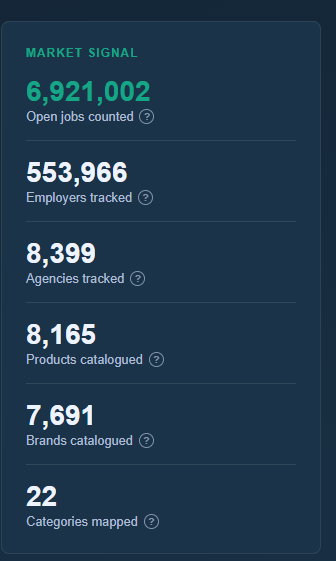
StackMarket is currently indexing over 550,000 employer career sites (so far), detecting 133 ATS platforms, and cataloguing 8,000+ recruitment technologies. That’s not a dataset – that’s a living organism. It shifts, grows, mutates, and occasionally does something so bizarre you have to double‑check it’s not a glitch.
Recruitment tech isn’t just fragmented. It’s atomised.
And that fragmentation isn’t just between vendors. It’s between countries, industries, company sizes, and even hiring philosophies. The ATS that dominates one region barely registers in the next. The tool beloved by SMEs is ignored by enterprises. And the product that’s “industry standard” in one sector is a complete unknown in another.
Take Teamtailor , for example. A Swedish ATS that has quietly – and sometimes not so quietly – taken Europe by storm. It holds 25% market share across Europe, which is impressive enough. But in Sweden? It’s not a market leader. It’s the whole market.
Teamtailor commands 76.2% market share in Sweden. Among SMEs, that rises to 88.3%.
That’s not dominance. That’s a monopoly wearing a friendly pink hoodie.

Meanwhile, on the other end of the spectrum, you have Workday – the enterprise titan. Among organisations with 5,000+ employees, Workday holds a 33% global market share. That’s a third of the world’s largest employers running their hiring through one system. If Teamtailor is the charming local hero, Workday is the multinational superpower with a private jet and a legal department the size of a small town.
These extremes matter because they reveal something deeper: recruitment technology isn’t a single market. It’s dozens of overlapping micro‑markets, each with its own logic, preferences, and gravitational pull.
There is no “global ATS leader.” There are only leaders of very specific universes.
And each of those universes behave differently.
In the US, ADP and Paylocity dominate SMEs. In the UK, Workable punches far above its weight. In Germany, JOIN has carved out a serious foothold (27.6%). In France, Teamtailor again – because apparently the French also enjoy a good Swedish export. In Brazil, Gupy is the surprise champion with 26.3%. In Norway, Teamtailor doesn’t just lead – it owns 64.4% of the market.

If you’re thinking, “This seems chaotic,” congratulations – you’re paying attention.
Recruitment technology has spent the last decade aiming to be a mature industry. But the data tells a different story. It’s still in very much flux. Still evolving. Still being shaped by regional quirks, regulatory pressures, cultural preferences, and the occasional vendor who accidentally becomes huge because one influential HR director liked their UI.
And this is where things get fun.
Because once we start tracking these patterns at scale – not monthly, not quarterly, but daily – we begin to see the recruitment industry for what it really is: a constantly shifting network of tools, behaviours, and decisions that no one has ever fully mapped before.
Until now.
We’re not just observing the market. We’re watching it breathe.
And the more we watch, the more we realise how much of recruitment tech’s “common wisdom” is built on assumptions that don’t survive contact with real data.
For example:
And this is exactly why StackMarket exists.
Because the industry doesn’t need another opinion. It needs evidence. It needs clarity. It needs a way to see the entire ecosystem – not just the loudest vendors or the most visible markets.
We’re building that. Piece by piece. Dataset by dataset. Signal by signal.
This article is the second step in a series that will gradually reveal what StackMarket is becoming – and why it matters. Much more will be shared at the NORA Recruitment Technology Conference in London on 18th November. We’re not rushing the reveal. Good stories deserve pacing. And this one is only just getting started.
But here’s your teaser:
Recruitment technology isn’t modular because it was designed that way. It’s modular because chaos won.
And we’re finally mapping the chaos.